
How high can the New Zealand Dollar fly?
How high can the New Zealand Dollar fly?
In this blog post, our friends at OrbitRemit analyze the recent changes in the price of the New Zealand Dollar (NZD) and discuss what lies ahead for the Kiwi currency.
The New Zealand dollar, otherwise known as the 'kiwi', has rapidly pushed higher to its current level at 0.683; a noteworthy achievement after three weeks of gains in a risk-off global financial environment. It's true that the currency was substantially oversold before the rally but compared to its similarly depreciated Australian counterpart, it's put in an impressive performance (NZD/USD chart below). Like it's namesake, the flightless bird, the NZ dollar could not get any lift from April to October as negative Chinese sentiment, Brexit and rising US rates affected emerging market and commodity driven currencies. On the 1st of November, the NZD/USD currency pair commenced its current ascent; partially due to unwinding expectations of the pace of US monetary tightening, but also because New Zealand's economy isn't doing too bad at all – despite the lack of business sentiment.
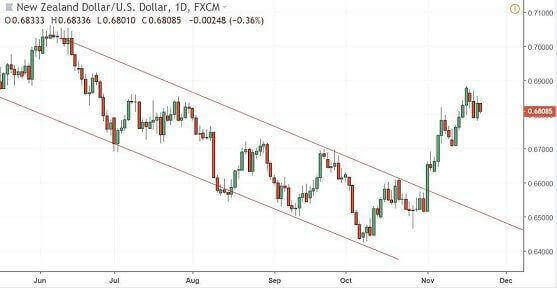
Let's have a look at some of the released domestic economic indicators:
- Labour market is tight with unemployment sitting dropping to 3.9%.
- GDP growth is expected to come out at a healthy 2.8% for the year.
- Purchasers Managers Index (PMI) rose to 53.5 from 51.9 in September.
- Performance of Services Index (PSI) rose to 55.4 from 53.9.
- The RBNZ in upbeat about future economic activity with lower interest rates and has slightly relaxed its dovish time.
- PPI (a gauge of inflation) is up due to increase fuel costs. Inflation expectations are stable and seemed to have bottomed out.
While this data has come out, US and China have been making efforts to come to an agreement and end the trade war while New Zealand has been busy preparing for the ratification of the Comprehensive and Progressive Agreement for Trans-Pacific Partnership (CPTPP). All these factors have justified the kiwi's appreciation – the question is, will the next wave of good news be enough to support its current level?
The best way to answer this question is to understand the biggest drivers of the exchange rate. Analysis of the NZD/USD currency pair seems to show that the biggest moves follow the release of information pertaining to US interest rate decisions and US financial market fluctuations (mainly the stocks and bonds market). Domestic drivers such as the dairy prices and tourism data are notably playing a role with volatility spiking following the release of industry data. With the New Zealand highly correlated to the Australian dollar, rightly or wrongly, the Australian dollar can also pull up or bring down the kiwi without it having much say in the matter.
With this in mind, the drivers of the kiwi point to an overcast future for it - despite its current strength. Here's why:
- The interest rate differential between the US and NZ continue to narrow with NZ interest rates on hold for the foreseeable future while the US continues to hike.
- Dairy prices have been declining since May.
- The Australian dollar continues to fall in tandem with commodity prices a result partially due to the Chinese economic slowdown.
- While NZ economic data is positive, the US's economy is considered to be doing even better.
- While global economies are healthy, we're at the later stages of the economic cycle. Safe-haven assets are currently being sought while riskier assets such as the NZ dollar and stocks are being abandoned.
Putting this all together, it seems that although the kiwi's recent appreciation is justified, it's hard to see its strength being maintained in the longer run. Its strength can be viewed as a temporary correction in the context of a longer-trend depreciating trajectory.
This is a guest post from OrbitRemit.
Categories


Similar Articles


Uzbekistan Money Transfers with Profee
Compare Profee's fees and exchange rates for Uzbekistan transfers, learn how transfer speed and security work, and follow five steps to send your first payment.

Wise vs Revolut: What Are The Differences?
Compare Wise vs Revolut on fees, exchange rates, features, and more. Find out which provider is better for your international money transfers.

How To Save On B2B International Transfer Fees
Learn how to reduce B2B international transfer fees. Discover faster, cheaper fintech alternatives for cross-border business payments.