
Tax Implications for Expats in Australia
Table of Contents
- About Australia
- What is Australia's Tax Assessment Year?
- When are Australian Tax Returns Due?
- Do Expats Have to Pay Tax in Australia?
- How can Expats in Australia Determine their Tax Residency Status?
- Resides Test
- Domicile Test
- 183-Day Test
- The Commonwealth Superannuation Test
- What if my Tax Residency Status Changed in a Tax Year?
- What is my Tax Status in Australia if I am not a Resident for Tax Purposes?
- What Types of Income do Expats in Australia have to Pay Taxes on?
- Taxable Income for Tax Residents in Australia
- Taxable Income for Foreign Residents in Australia
- Taxable Income for Temporary Residents in Australia
- What Types of Tax Deductions can Expats in Australian Claim?
- What is Tax Rate for Foreigners and Expats in Australia?
- Do Expats in Australia Have to Pay Tax on Capital Gains?
- What is the 50% CGT Discount for Foreigners and Expats in Australia?
- Which Capital Assets are Subject to Capital Gains Tax in Australia?
- Can I get Double Taxed as an Expat in Australia?
- Option 1: Claim an Australian Foreign Income Tax Offset
- Option 2: Take Advantage of Tax Treaty with Australia
- Conclusion
If you are an expat living in Australia, it is important to be aware of the tax implications. The Australian government imposes income tax, capital gains tax, and several other taxes which can also apply to foreigners living in Australia.
In this article, we will discuss the different types of tax related rules and regulations that apply to Australian expats. Knowing these will help you avoid potential issues and costly mistakes.
The information presented in this article is for informational purposes only. Remember to always consult an Australian tax professional for advice about your individual tax situation and needs.
About Australia
Australia, officially called the Commonwealth of Australia, comprises of mainland Australia, the island of Tasmania and several other smaller islands. Australia is the 6th largest country in the world.
Australia has a vibrant economy that centers around large services, industries and agriculture. High levels of competition and economic freedom contribute to making the country an attractive place for expats.
Foreigners from all over the world come to study, work, and live in Australia. Many of these Australia expats often choose to settle in Australia and make it their permanent home.
It is, therefore, no surprise that the topic of taxation is of high interest to a large community of expats living in Australia.
Australia has a booming economy and is home to foreigners and expats from all over the world.
Let's delve into details of various Australia tax related topics with a special focus on expats. We will start with the definition of the Australian Tax Assessment Year.
What is Australia's Tax Assessment Year?
Australian taxation is under the authority and purview of the Australian Taxation Office (ATO) which is the primary revenue collection agency of the Government of Australia.
As per ATO's rules and regulations, Australia's Tax Assessment Year runs from July 1 to June 30 of the following year.
Since the Tax Year bridges two calendar years, it is common to see Australian Tax Years as 2021-22. In this example, Tax Year 2021-22 represents the period from July 1, 2021 through June 30, 2022.
Australian Tax Year runs from July 1 through June 30 of the next calendar year.
This means that for the income tax return for the Tax Year 2021-22, you will need to include your income from July 1, 2021 through June 30, 2022.
When are Australian Tax Returns Due?
Based on the ATO's guidelines, Australian Tax Returns are due on October 31 each year. In case October 31 falls over a weekend, the due date is the next business day after October 31.
Extending on our earlier example, for the Australian Tax Year 2021-22 (which covers income earned between July 1, 2021 through June 30, 2022), you must file your taxes by October 31, 2022.
Additionally, if you owe taxes to the ATO, you must make those tax payments by November 21 regardless of whether you file your income tax return on time by October 31 or later.
Australian Tax Returns must be filed by October 31, and any tax payments must be made to the ATO by November 21.
Do Expats Have to Pay Tax in Australia?
First off, the Australian Taxation Office (ATO) provides a lot of helpful information1 on tax related matters for expats in Australia, as well as Australians planning on going abroad.
Below is a screenshot of the dedicated section on the ATO site that you can always use as a reference.
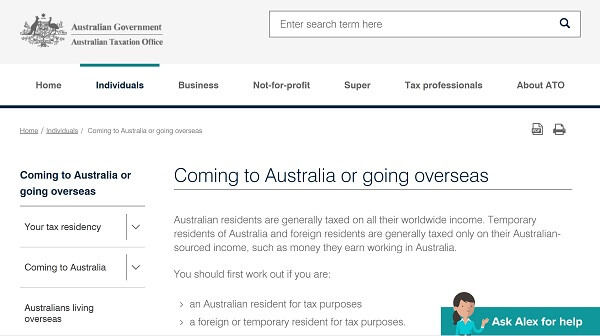
On a high level, ATO guidelines dictate the below rules for who will pay taxes in Australian and on what income:
- Australian residents get taxed on their income in Australia as well as their worldwide income.
- Temporary Australian residents and foreign residents generally get taxed on their income in Australia only.
Note that even if the 2nd clause above applies to you, you may still have to pay taxes on income derived from other countries in those countries. Please refer to the tax rules of those countries or consult with relevant tax professionals there.
If you are an expat in Australia and are deemed a resident for tax purposes, you will need to pay taxes on your income in Australia.
The ATO provides detailed guidance on what types of income will be taxed as well as tax tables for actual tax computation if you are considered a tax resident in Australia.
But before we proceed further, let us first deep dive into the rules to determine Australian residency for tax purposes.
How can Expats in Australia Determine their Tax Residency Status?
If you are an expat in Australia, the tax treatment that will be applicable to your income depends on a very important factor – your tax residency status.
Many people get confused between citizenship and permanent residency from an immigration and tax residency perspective. Note that tax residency is very different from citizenship or immigration status. For instance, you do not need to be an Australian citizen or permanent resident to be an Australian resident for tax purposes.
You are considered an Australian resident for tax purposes if you meet any of the below criteria:
- You came to Australia from overseas as an expat and live there permanently.
- You have been in Australia for a continuous period of 6 months and have held the same job and lived at the same place for most of that time.
- You have been in Australia for more than 6 months in a year, unless you do not intent to live in Australia and your home in overseas.
- You visit other countries temporarily and do not have a permanent home there.
- You are an overseas student studying in Australia and your degree or course is longer than 6 months long.
To further disambiguate the definition of the tax residency, the ATO defines the following 4 tests.
Resides Test
The resides test is the primary test that the ATO uses to determine your tax residency. If you meet the resides test, you do not need to even consider the other tests.
Simply put, if you reside in Australia, you are a resident for tax purposes. Below is the criteria that the ATO uses to determine if you reside in Australia:
- physical presence
- intention and purpose
- family
- business or employment ties
- maintenance and location of assets
- social and living arrangements
If you do not meet the resides test, you will be evaluated on the following tests. Meeting any one of the below tests will qualify you to be a tax resident in Australia.
You will qualify as a resident of Australia for tax purposes if you meet the resides test or any one of the other 3 tests.
Domicile Test
The domicile test states that if your permanent home is in Australia, then you are considered an Australian domicile and hence a resident for tax purposes.
To avoid any ambiguity on this, the ATO publishes detailed guidelines on how to apply and use the domicile test2.
183-Day Test
The 183-day test is especially relevant to you if you are an expat living in Australia. Based on the 183-day test, you will be considered a tax resident of Australia if you stay in Australia for more than half the year, i.e., at least 183 days.
Few important things that you should be aware of when applying this test:
- The 183 day period need not be continuous. In other words, even if there are breaks in your stay but your cumulative stay in Australia in a year is more than 183 days, you will qualify as a tax resident.
- The year of reference here is the tax year. Recall that Australia Tax Year is July 1 to June 30. So, when you apply the 183-day test, make sure to use the tax year and not the calendar year from January 1 to December 31.
Once again, the ATO publishes detailed guidelines on the 183-day test3 to avoid any doubts or confusion on how this test is applied and used.
The Commonwealth Superannuation Test
The Commonwealth Superannuation Test applies to Australian Government employees who are posted overseas.
If you are a foreigner or expat living in Australia, you may not have to worry about this test unless you work for the Australian Government and are sent overseas to work.
Make sure to study the Australian Tax Residency rules carefully to determine your tax status. If in doubt, consult a tax professional.
As you can see from the above discussion, the 183-day test may be a very important factor in determining tax residency status for expats in Australia. This is especially relevant if you travel in and out of Australia frequently.
Given that, we strongly recommend you keep track of all your travel dates so it is easy to calculate your actual stay in Australia during a tax year. This will help you ensure you do not miscalculate your tax residency status and make costly mistakes.
If you are an expat in Australia who travels internationally a lot, make sure to keep track of your travel dates so you can compute if you meet the 183-day test or not.
If you are an expat in Australia and are considering leaving and going back to your home country, there is another highly relevant taxation scenario that may potential apply to you. We present this below.
What if my Tax Residency Status Changed in a Tax Year?
In case your tax residency status changes in a tax year, you should report your tax status as resident on your income tax return.
The ATO will apply a pro-rata tax free threshold to determine how much of your income is tax free. This is calculated as below:
Tax-free threshold amount = AUD 13,464 + AUD 4,736 x (Number of months you were a tax resident / 12)
For example, if you are an Australian expat and a tax resident in Australia, but decide to leave the country permanently in December, your tax-free threshold amount will be calculated as below using the 6 months from July through December that you were an Australian tax resident:
Tax-free threshold amount = AUD 13,464 + AUD 4,736 x (6/12) = AUD 15,832.
This means that you would not need to pay any tax on the first AUD 15,832 income for that tax year.
What is my Tax Status in Australia if I am not a Resident for Tax Purposes?
If you are an expat or foreigner living in Australia and you do not meet any of the tax residency tests, then you are not considered an Australia resident for tax purposes.
In case you are not deemed a resident in Australia for tax purposes, you will belong to one of the below categories:
- Foreign resident: Anyone who is not an Australian resident for tax purposes will be a foreign resident by default.
- Temporary resident: If you have a temporary via in Australia, and neither you nor your spouse is an Australian citizen or permanent resident, you will be considered a temporary resident for tax purposes.
The types of income that gets taxed in Australia as well as any applicable deductions are all dependent on your tax status.
Tax residents, foreign residents and temporary residents all report income and deductions in different ways. We will cover that next.
Tax treatment in Australia for residents, foreign residents and temporary residents is different.
What Types of Income do Expats in Australia have to Pay Taxes on?
As you are aware by now, the type of income you report for taxes in Australia depends on your tax residency status.
Below, we prove the list of reportable income for Australian tax residents, foreign residents and temporary residents.
Taxable Income for Tax Residents in Australia
If you are an Australian resident for tax purposes, you will need to report the below income on your tax return:
- Employment income including salary, wages, cash, allowances, fringe benefits and super contributions.
- Superannuation pensions and annuities.
- Various government payments and allowances like age pension, carer payment, Austudy and JobSeeker payments, Youth allowance, veteran payment, etc.
- Investment income like rent, interests, dividends and capital gains.
- Business, partnership and trust income.
- Foreign and worldwide income that includes employment income, business and investment income, capital gains on overseas assets and pensions and annuities.
- Other income like compensation income, insurance payments and prizes and awards.
- Income from other sources like crowdfunding and personal services income may also be taxable.
If you are an expat in Australia who qualifies as a tax resident, you must report all your Australian as well as foreign income on your tax return.
Taxable Income for Foreign Residents in Australia
If you are not an Australian resident for tax purposes, you are considered a foreign resident. Foreign tax residents only need to report their income earned in Australia.
If you are a foreign resident, you will need to repot the below Australian-sourced income on your tax return:
- Employment income.
- Rental income.
- Pensions and annuities earned in Australia, unless an exemption is available under Australian tax law or a tax treaty.
- Capital gains on assets within Australia.
If you are an expat in Australia who qualifies as a foreign resident for tax purposes, you must only report your Australian income on your tax return.
Taxable Income for Temporary Residents in Australia
If you are a foreigner or expat in Australia and hold a temporary via, and neither you nor your spouse is an Australian citizen or permanent resident, you are classified as a temporary resident for tax purposes.
As a temporary resident in Australia, you only have to declare the below 2 types of income on your Australian tax return:
- Income you earned in Australia.
- Income you earned from overseas employment or services while you are a temporary resident of Australia.
If you are a temporary resident for tax purposes, you must only report income earned in Australia or from overseas employment during your stay in Australia.
This covers our analysis of which income is taxable for residents, foreigners and temporary residents in Australia.
If you have any doubts on which income you should report, you should check the ATO website and consult with your tax consultant for professional advice.
What Types of Tax Deductions can Expats in Australian Claim?
Much like taxable income, the types of tax deductions that a foreigner or expat in Australia can claim are also dependent on the tax residency status. Let's look at the possible deductions for tax residents and foreigners in Australia.
The biggest difference when it comes to deductions is that Australian tax residents get a tax-free threshold income which is free from taxes.
Foreign residents and temporary residents, on the other hand, do not get any tax-free threshold income – this means that they have to pay tax on every single Australian Dollar of income they earn in Australia.
Australian tax residents get a tax-free threshold income. Foreigners and temporary tax residents do not get the tax-free threshold and have to pay tax on full income in Australia.
The other possible tax deductions that are available as per ATO guidelines include the below:
- Work related expenses
- Other expenses like cost of managing tax affairs
- Gifts and donations made
- Deductions on interest, dividends and other investment income
- Income protection insurance
If in doubt whether your expense qualifies as a deduction or not, consult the ATO guidelines or a qualified tax professional.
Now that we have listed the possible deductions, we want to go over the tax-free threshold in a bit more detail as per below.
What is the Tax-Free Threshold in Australia?
The tax-free threshold is a minimum amount on which the Australian Taxation Office (ATO) does not charge income taxes.
Currently, this amount is set at AUD 18,200. This means that if you are an Australian tax resident and eligible to claim the tax-free threshold, your first AUD 18,200 income is tax free.
The tax-free threshold is the minimum income on which you pay no income tax. It is currently AUD 18,200.
In case you are an Australian resident for part of the year (this may happen is you are generally a resident, and decide to leave Australia), then your tax-free threshold for that tax year is calculated as below:
- A fixed amount of AUD 13,464, plus,
- A pro-rated amount of AUD 4,736 for the months you were a tax resident in Australia
As an example, if you leave Australia in December of a tax year, your tax-free threshold will be AUD 15,832 (13,464 + 4,736 x (6/12)).
What is Tax Rate for Foreigners and Expats in Australia?
The actual tax that you pay as a foreigner or expat in Australia depends on your tax residency status. Below, we cover the tax rates for both residents and foreigners.
Tax Rate for Residents in Australia
If you are an expat in Australia and qualify as a resident for tax purposes, you will have to pay anywhere from 0% to 45% tax on your income.
The actual tax rate4 depends on the taxable income and is as per the below table.
| Taxable Income | Income Tax |
|---|---|
| 0 – $18,200 | $0 |
| $18,201 – $45,000 | 19% for income over $18,200 |
| $45,001 – $120,000 | $5,092 plus 32.5% for income over $45,000 |
| $120,001 – $180,000 | $29,467 plus 37% for income over $120,000 |
| $180,001 and over | $51,667 plus 45% for income over $180,000 |
These rates are the same for tax years 2022-23 as well as 2021-22.
Tax Rate for Foreigners in Australia
If you are an expat in Australia and qualify as a foreigner for tax purposes, you will also have to pay anywhere from 0% to 45% tax on your income.
That said, the tax tiers for foreign residents5 are different from those of residents, and are captured in the below table.
| Taxable Income | Income Tax |
|---|---|
| $0 – $120,000 | 32.5% |
| $120,001 – $180,000 | $39,000 plus 37% for income over $120,000 |
| $180,001 and over | $61,200 plus 45% for income over $180,000 |
Like the tax rates for residents, these rates for foreigners are also the same for tax years 2022-23 as well as 2021-22.
Much like other countries, income tax rates in Australia are also tiered and vary by taxable income.
Do Expats in Australia Have to Pay Tax on Capital Gains?
The short answer is yes, foreigners and expats living in Australia have a pay capital gains tax.
That said, there are quite a few important caveats when it comes to capital gains tax in Australia. We cover some important points below.
As we have seen throughout our analysis of Australian income, deductions and taxes so far, capital gains tax is also dependent on your tax residency status. Here are the rules as per ATO guidelines for Capital Gains Tax (CGT):
- If you are an Australia resident for tax purposes, you need to report capital gains on both Australian as well as foreign capital assets, and both may be taxable in Australia.
- If you are considered a foreign resident for Australian tax purposes, you are only subject to capital gains for assets held within Australia. You do not need to report capital gains on your foreign assets.
Capital gains are generally always taxable for Australian assets whether you qualify as a resident or foreigner for Australian tax purposes.
There is another important caveat for foreign residents when it comes to capital gains in Australia, and it is called the 50% CGT discount. We cover this topic below.
What is the 50% CGT Discount for Foreigners and Expats in Australia?
If you qualify as a foreign resident or a temporary resident based on Australian tax residency rules, you could qualify for a 50% Capital Gains Tax (CGT) discount.
To be able to use the 50% capital gains tax discount, you must fulfil the following 2 conditions:
- The asset for which you want to claim the 50% CGT discount was acquired before 8th May, 2012.
- You were an Australian resident after 8th May, 2012 for a period of time.
If you do not meet both of the above conditions, you cannot claim the 50% CGT discount for your capital gains.
Which Capital Assets are Subject to Capital Gains Tax in Australia?
If you are an Australian resident for tax purposes, capital gains from any of the below assets are subject to capital gains tax:
- Real estate including rental properties, vacation homes, businesses and land.
- Shares and similar investments.
- Cryptocurrency unless used for personal use.
- Personal use assets if the asset was acquired for more than AUD 10,000.
- Collectibles like art, jewelry, antiques, coins, etc. if the asset was acquired for more than AUD 500.
- Intangible assets like leases, licenses and contractual rights may be subject to CGT.
- Foreign currency.
The following assets are generally exempt from Capital Gains Tax:
- Your primary residence unless you are a foreign resident for tax purposes and do not pass the Life Events Test.
- Eligible granny flat arrangements.
- Cars and motorcycles.
- Cryptocurrency held and used for personal use.
- Personal use assets that were acquired for less than AUD 10,000.
- Collectible that were acquired for less than AUD 500.
- Certain depreciating assets may be exempt from CGT.
- Certain awards and legal or injury related payouts may be exempt from CGT.
Make sure to carefully examine which capital assets produce taxable gains and which are exempt from taxation.
For a full and exhaustive list of which assets may or may not be exempt from capital gains tax, check out ATO's guidelines on CGT assets and exemptions6.
Can I get Double Taxed as an Expat in Australia?
One of the biggest concerns that you may have as a foreigner or expat in Australia is double taxation. This is a real concern since you have to report your worldwide income to the Australian Taxation Office (ATO) if you qualify as a resident for tax purposes.
There are quite a few important caveats to potential double taxation when paying taxes in Australia, and we will cover these below.
First and foremost, if you do not qualify as a tax resident in Australia, you do not have to report your foreign income. In other words, if you are a foreign resident or temporary resident for Australian tax purposes, you do not need to pay taxes in Australia for your foreign income and assets, and hence the potential issue of double taxation does not arise.
If you are a foreign resident or temporary resident for Australian tax purposes, you do not have to report foreign income and assets, and will avoid potential double taxation in Australia.
The situation is obviously different if you are an expat who qualify as a tax resident in Australia since you need to declare your foreign income and pay taxes on it. In the worst case, you may have to pay double tax and then claim a refund in one of the countries.
That said, there are 2 mitigating controls in place to avoid potential double taxation for Australian tax residents as below.
Option 1: Claim an Australian Foreign Income Tax Offset
If you have already paid tax on your foreign income to another country, you may be able to claim a Foreign Income Tax Offset7 on your Australian income tax return.
To be able to claim the Foreign Income Tax Offset in Australia, the following conditions must be met:
- You must have actually paid the foreign income tax to the taxation authorities in the foreign country.
- The income or gain for which you paid the foreign tax must be included on your Australian income tax return.
There are lots of details and caveats to the topic of Foreign Income Tax Offsets so make sure to check out ATO's detailed guide on this topic.
Option 2: Take Advantage of Tax Treaty with Australia
To help Australian tax residents avoid potential double taxation, Australia has entered into tax treaties with more than 40 countries that include all major Australian trade and investment partners.
Australian tax treaty partners include numerous countries across all continents. In fact, the Australian treasury site maintains a list of all of Australia's tax treaty partners8. Make sure to look up your home country to see if you can take advantage of this.
If your home country has a tax treaty with Australia, you can take advantage of this to avoid potential double taxation. You can request the ATO to issue a Certificate of Residency, which basically certifies that you are an Australian resident for tax purposes.
Once you obtain your Certificate of Residency from the ATO, you can use it to avoid double taxation by reaching out to your home country's tax authorities and request either of the following:
- You can get your tax withholding reduced so that you pay lower taxes in your home country. This will obviously minimize potential double taxation.
- You can request to be exempted from paying tax in your home country. This will altogether eliminate double taxation as you will pay tax only in Australia.
Make use of Australian Foreign Income Tax Offsets or Tax Treaties to minimize or avoid potential double taxation on foreign income.
Conclusion
If you are an expat or a foreigner visiting, working, studying or living in Australia, you need to be aware of Australian tax policies and laws. Tax mistakes can be costly and time consuming to fix, so make sure you are up to date with the right knowledge and data.
The first thing to determine is your tax residency status in Australia. This will help you determine which income do you need to report and which deductions and exemptions are available to you. Your final tax amounts are also dependent on your tax residency status.
Finally, when in doubt, make sure to consult Australian Taxation Office (ATO) guidelines and publications, and consult with tax professionals in Australia.
The information presented in this article is for educational and informational purposes only and is not meant to be tax advice. Please consult with a tax consultant for professional advice on Australian tax laws.
Do You Need To Find the Best Remit Exchange Rate for Sending Money Internationally?
RemitFinder is an online service that helps you track remit exchange rates. By checking and comparing the latest remit exchange rates, you can get the best exchange rate for your money transfers. RemitFinder, thus, helps you to get the best return for your hard-earned money.
Find the cheapest rate to transfer your hard-earned money - visit our site or download the app on Google Play or Apple App Store now.
Want to explore by country? Browse all destination countries on our send money to hub or sending countries on our send money from hub.
References:
1. ATO guide for tax treatment of foreigners and expats in Australia
2. ATO guidelines on how to apply the Domicile Test for tax residency
3. ATO guidelines on how to apply the 183 Day Test for tax residency
4. Australian tax rate for residents
5. Australian tax rate for foreigners
6. ATO's guidelines on capital gains, taxable assets and exemptions
7. ATO's guidelines on Foreign Income Tax Offset
8. Australian Treasury list of countries Australia has income tax treaties with
Categories


Similar Articles

Tax Treatment On Sale Of Property By NRI In India
Learn the tax implications for NRIs selling property in India. Understand key rules, deductions, and how to stay compliant with regulations.

Popular Mobile Wallets In Middle East And Africa
Explore popular mobile wallets in the Middle East and Africa and how they support financial inclusion and digital payments.

Popular Mobile Wallets In North America
Discover the most popular mobile wallets in North America and how they simplify payments, transfers, and everyday transactions.