
How Does UPI-PayNow Integration Work?
Table of Contents
- What Is UPI?
- What Is PayNow?
- How Does UPI-PayNow Integration Work?
- Which Indian banks support UPI-PayNow integrated payments?
- Which Singapore banks support UPI-PayNow integrated payments?
- What Are The Benefits Of UPI-PayNow Integration?
- What Are The Technical Aspects Of UPI-PayNow Integration?
- Is It Safe To Use UPI-PayNow Integrated Payments?
- The Impact Of UPI-PayNow Integration On Digital Payments
- The Future Of UPI-PayNow Integration
- Frequently Asked Questions About UPI-PayNow Integration
- What is the UPI-PayNow limit for transfers made from India?
- How quickly does a UPI-PayNow payment complete?
- Do the remittance limits of Liberalised Remittance Scheme (LRS) apply to remittances sent from India using UPI-PayNow?
- Conclusion: RemitFinder's Take On The Future Of UPI-PayNow
The integration of UPI and PayNow payment systems has been making headlines in the world of digital payments.
The Unified Payments Interface (UPI) is a popular payment system in India that allows users to transfer money from one bank account to another instantly. At the same time, PayNow is a similar payment system in Singapore that allows for fast and secure fund transfers between banks.
The integration of UPI and PayNow payment systems aims to make cross-border payments easier and more efficient for individuals and businesses in both countries. This integration enables users to transfer funds seamlessly between Singapore and India without relying on intermediaries.
In this article, we will dive deeper into how UPI-PayNow integration works, the benefits it offers, and the technical work behind it. We will also explore the user experience, security measures, and the future potential of UPI-PayNow integration in revolutionizing cross-border payments.
What Is UPI?
Unified Payments Interface (UPI) is a payment system that facilitates money transfers between bank accounts through a mobile phone. Launched by the National Payments Corporation of India (NPCI) in 2016, it has since become a popular mode of payment among Indians.
UPI operates on the Immediate Payment Service (IMPS) platform, enabling users to transfer funds instantly from one bank account to another. It eliminates the need for multiple banking apps and allows users to transact from one app. UPI payments can be made 24/7, including weekends and public holidays.
To use UPI, users need to have a bank account and a mobile number registered with the bank. They also need to download a UPI-enabled app from their respective app stores. Once the app is downloaded, users must register their bank account details and create a UPI ID. This UPI ID acts as a virtual payment address and can be used to make and receive payments.
In the UPI payment ecosystem, a UPI ID is a unique identifier for every user and can be used to send payments to them.
UPI offers several benefits over other payment methods. It is easy to use, secure, and free of cost. Users can transfer funds up to Rs. 1 lakh per transaction using UPI, and there is no limit on the number of transactions that can be made in a day.
UPI also supports various payment modes, including QR Code scanning, account number and IFSC code, mobile number and MMID.
UPI has revolutionized the payments landscape in India and has played a significant role in driving digital payments adoption. It has also helped to promote financial inclusion by making banking services more accessible to people in remote areas. As more and more people adopt UPI, it is expected to become the dominant payment system in India.
What Is PayNow?
PayNow is a real-time peer-to-peer funds transfer system that operates in Singapore. It was launched in 2017 by the Association of Banks in Singapore (ABS) and is regulated by the Monetary Authority of Singapore (MAS).
PayNow allows individuals and businesses to send and receive money instantly using their mobile number or National Registration Identity Card (NRIC) number or Foreign Identification Number (FIN) or Unique Entity Number (UEN).
PayNow is an electronic payment system that is linked to the user's bank account. To use PayNow, users need to register their mobile or NRIC/FIN numbers with their bank and link them to their bank account. Once the registration is complete, users can transfer funds instantly to any other user who is also registered with PayNow.
PayNow is backed by a bank account, and users can link it with their mobile number, Singapore NRIC/FIN or UEN (for businesses).
PayNow is available 24/7, and there is no limit on the amount of money that can be transferred. It is a secure payment system that uses the same security standards as internet banking, including two-factor authentication (2FA) and encryption. PayNow also allows users to check their transaction history and balance in real time.
PayNow has become a popular payment method in Singapore, with over 5 million users as of 2021. It is widely used for peer-to-peer transactions, such as splitting bills, paying for goods and services, and sending money to friends and family.
PayNow is also increasingly being adopted by businesses as a payment method, enabling customers to pay for goods and services instantly.
How Does UPI-PayNow Integration Work?
UPI and PayNow have come together since February 21, 2023 to create a direct link between both systems, thereby allowing users in India and Singapore to send fast, secure and seamless cross-border money transfers and payments 24x7.
With the UPI-PayNow linkage, customers of participating banks and Non-Bank Financial Institutions (NFIs) in both countries will be able to use their banks to send money between India and Singapore.
Below is how the UPI-PayNow integrated system can be used by users in both countries to send money to each other.
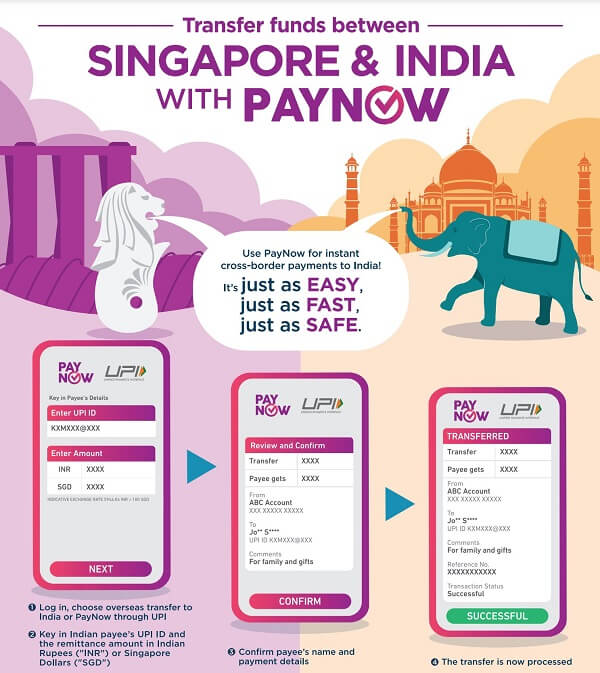
- A PayNow customer in Singapore who wants to send money to someone in India can use the recipient's UPI ID - which is globally unique within the UPI ecosystem - to send money to them.
- A UPI user in India who wants to send money to someone in Singapore can use the recipient's registered PayNow mobile number or Virtual Payment Address (VPA) - both of which are globally unique within the PayNow ecosystem - to send funds to them.
Both PayNow users in Singapore and UPI users in India can send money to each other by using the recipient's unique identifier in their respective payment system.
This makes cross-border payments between India and Singapore totally frictionless without any reliance on intermediary parties or systems.
The below infographic from the Association of Banks in Singapore (ABS) captures the essence of UPI-PayNow integration1 really well.
Let's also see which banks support UPI-PayNow integrated payments in both countries.
Which Indian banks support UPI-PayNow integrated payments?
Currently, the following Indian banks support sending and receiving money via the UPI-PayNow integration:
- State Bank of India - both inward and outward remittances
- Indian Overseas Bank - both inward and outward remittances
- Indian Bank - both inward and outward remittances
- ICICI Bank - both inward and outward remittances
- Axis Bank - inward remittances only
- DBS India - inward remittances only
Which Singapore banks support UPI-PayNow integrated payments?
At this time, the following 2 entities in Singapore support the UPI-PayNow integration for sending and receiving cross-border payments:
- DBS Bank
- Liquid Group (a Non-Bank Financial Institutions, i.e., NFI)
It is possible and likely that more banks and financial institutions will adopt UPI-PayNow integrated payments in the future. Check with your bank to see if they allow you to take advantage of UPI-PayNow linkage.
What Are The Benefits Of UPI-PayNow Integration?
The integration of UPI and PayNow brings several benefits to users in both India and Singapore.
By integrating the two systems, users in India and Singapore can send and receive money instantly and securely using just their mobile number or NRIC number. This can make cross-border transactions faster, easier, and more convenient, eliminating the need for international wire transfers or other traditional methods of cross-border payments.
Additionally, integrating UPI and PayNow can help promote digital payment adoption and financial inclusion.
Users in India and Singapore who may not have access to traditional banking services can still use UPI and PayNow to make and receive payments, enabling them to participate in the digital economy. This can help to drive economic growth and create new business opportunities.
The integration of UPI and PayNow can also benefit businesses operating in India and Singapore. Companies can simplify their payment processes, reduce transaction costs, and improve cash flow management by using a single payment system for both markets. This can help businesses to expand their operations and reach new customers in both countries.
Furthermore, integrating UPI and PayNow can help promote cross-border trade and investment.
By enabling faster and more convenient cross-border payments, businesses can increase their competitiveness and expand their international reach. This can strengthen economic ties between India and Singapore and promote greater cooperation in trade and investment.
UPI-PayNow integration makes it easy for both individuals as well as businesses in Singapore and India to send and receive payments from each other.
What Are The Technical Aspects Of UPI-PayNow Integration?
The integration of UPI and PayNow requires technical coordination between the two systems. UPI and PayNow use different protocols for transferring funds; therefore, the systems need to be integrated at the backend level.
To integrate UPI and PayNow, the two systems must be able to communicate with each other. This requires the development of APIs (Application Programming Interfaces) that allow the two systems to exchange information securely. The APIs must be developed to ensure that they are compatible with each other and adhere to security standards.
Once the APIs are developed, the UPI and PayNow systems must be configured to recognize and accept transactions from each other. This requires the development of rules and regulations for transaction processing.
The integration process also involves testing to ensure the integration works as intended. Testing involves simulating transactions and verifying that the funds are transferred correctly between the two systems.
In addition to technical coordination, the integration of UPI and PayNow also requires regulatory coordination. This involves ensuring that the integration complies with the regulations of both countries and that the transaction flows are secure and transparent.
The technical and backend integration of UPI and PayNow requires significant effort and expertise. It involves developing APIs, configuring systems, and testing to ensure that the integration works seamlessly.
However, the benefits of integrating the two systems are significant, including faster and more convenient cross-border payments, increased financial inclusion, and greater opportunities for trade and investment. As a result, the integration cost and effort is worth it.
Is It Safe To Use UPI-PayNow Integrated Payments?
The integration of UPI and PayNow requires robust security features to ensure the safety and security of users' transactions. Both UPI and PayNow have strong security features in place, and the integration of the two systems must maintain and enhance these features.
One of the key security features of UPI and PayNow integration is the use of two-factor authentication (2FA). 2FA is a security process that requires users to provide two forms of identification, such as a password and a one-time password (OTP), to access their accounts. This helps to prevent unauthorized access to funds and ensure that only authorized users can initiate transactions.
Another security feature is encryption. Encryption is the process of converting information into a coded format to prevent unauthorized access. UPI and PayNow use encryption to secure users' transaction data and ensure that unauthorized parties cannot intercept or access it.
The integration of UPI and PayNow also involves the implementation of rules and regulations to comply with legal, regulatory and compliance requirements. These rules and regulations ensure that transactions are processed securely and transparently and that users' funds are protected from fraud and other financial crime.
In addition to these security features, UPI and PayNow also have monitoring and reporting mechanisms to detect and prevent fraudulent activities. These mechanisms include real-time transaction monitoring, suspicious activity reporting, and fraud detection and prevention tools.
Overall, the integration of UPI and PayNow requires strong security features to ensure the safety and security of users' transactions. Using two-factor authentication, encryption, and robust monitoring and reporting mechanisms are crucial to ensuring the integrity of the transaction process and preventing fraudulent activities.
Both UPI and PayNow implement several security guidelines, protocols and best practices. This helps both systems keep your money and information safe.
The Impact Of UPI-PayNow Integration On Digital Payments
The integration of UPI and PayNow is expected to significantly impact digital payments in India and Singapore in positive ways.
For example, UPI-PayNow linkage will:
- Help users in both countries can send cross-border payments easily, securely and in a cost-effective manner.
- Boost digital payment adoption and promote financial inclusion for people who have not had access to banking services in the past. More people will, thus, participate in the digital economy and help drive growth and opportunities.
- Make it more cost-effective for businesses in both countries by reducing their operational costs when it comes to international payments.
- Benefit the e-commerce industry by providing a more streamlined payments for cross-border e-commerce transactions, making it easier for customers to purchase products from sellers in both countries.
- Promote greater cooperation between India and Singapore in trade and investment. Faster and more convenient cross-border payments can strengthen economic ties between the two countries and promote greater cooperation in trade and investment.
The integration of UPI and PayNow is expected to positively impact digital payments in India and Singapore by creating a more seamless and efficient payment landscape that benefits everyone.
The Future Of UPI-PayNow Integration
The integration of UPI and PayNow is still in its early stages, but its potential for growth and development is significant. As more users adopt digital payments, UPI-PayNow integrated payments will likely become increasingly important in facilitating cross-border transactions.
One potential growth opportunity is the expansion of the integration to other regional countries. As neighboring countries look to develop their digital payment systems, UPI and PayNow could become the standard for cross-border payments in Southeast Asia.
Another possibility is the expansion of UPI and PayNow to support other types of transactions, such as cross-border remittances, loan payments for education and real estate and bill payments. This would further enhance the convenience and flexibility of the payment systems, making them even more attractive to users.
The integration could also lead to the development of new payment services and products. For example, it could facilitate the development of mobile wallets that can be used across multiple countries, making it easier for users to manage their finances and make transactions while traveling.
In addition, the integration could lead to greater collaboration between Indian and Singaporean companies in the fintech sector. By working together, companies could develop new technologies and products that cater to the needs of both markets.
The future of UPI-PayNow integration is promising. As digital payments continue to grow in popularity, the integration is likely to play an increasingly important role in facilitating cross-border transactions in not just India and Singapore, but also other South-East Asian countries.
Various possibilities and increasing adoption of UPI-PayNow integrated payments certainly points to a bright future for both UPI and PayNow.
Frequently Asked Questions About UPI-PayNow Integration
Here are some additional Frequently Asked Questions (FAQs) about the UPI-PayNow integration that have not already been answered in prior sections of this article.
What is the UPI-PayNow limit for transfers made from India?
As per the regulations of the Reserve Bank of India (RBI), the current daily limit of transfers done via UPI-PayNow from India is INR 60,000. This will come out to around SGD 1,000 based on the ongoing SGD-INR exchange rate.
Note that the regular transaction limit for UPI transactions in India is INR 1,00,000 per day. In that sense, the transfer limit for UPI-PayNow transfers from India is still lower than the regular UPI limit for domestic transactions.
How quickly does a UPI-PayNow payment complete?
UPI-PayNow transactions generally finish within a minute. This is because both UPI and PayNow are able to process transactions almost instantaneously within their respective countries.
Do the remittance limits of Liberalised Remittance Scheme (LRS) apply to remittances sent from India using UPI-PayNow?
As per the guidance from the Reserve Bank of India (RBI), remittances sent from India using the UPI-PayNow integration are classified under the categories of "Maintenance of Relatives Abroad" & "Gift".
In that sense, these payments are considered as personal payments, and hence they do count as part of the remittance quota specified as per the Liberalised Remittance Scheme (LRS). In other words, regular LRS limits would apply to remittances sent via the UPI-PayNow link.
Conclusion: RemitFinder's Take On The Future Of UPI-PayNow
Based on our observations, the integration of UPI and PayNow has the potential to revolutionize digital payments by facilitating seamless cross-border transactions between India and Singapore.
The connection between UPI and PayNow provides a fast, convenient, and secure way for individuals as well as businesses to make and receive payments. In that sense, it is beneficial to consumers, businesses, e-commerce industry, public sector organizations and budding startups alike.
To ensure the continued success of the UPI-PayNow linkage, it will be important for both sides to continue to focus on security and safety - an uncompromisingly important factor in today's global, digital economy. It is also be crucial to continue to evolve rules and regulations to protect users' funds and information from fraud and other financial crimes.
We also believe that with UPI and PayNow coming together and continuing to grow, the collaboration between Indian and Singaporean fintech companies will only increase. This can lead to the development of new technologies and products that cater to the needs of both markets.
Expanding the integration to other countries in the region and supporting new types of transactions are additional opportunities that we can see on the horizon at some point of time. Needless to say, these will further enhance the convenience and flexibility of the payment systems in the overall South-East Asian region.
In summary, we believe that the UPI-PayNow integration enables both individuals and businesses in Singapore to collaborate, innovate and develop new products and solutions together. All this will only serve to benefit one and all, and promote economic growth.
We believe that the future of UPI and PayNow integration is bright, and it will continue to revolutionize how people make and receive payments in this digital age.
Do You Need To Find the Best Remit Exchange Rate for Sending Money Internationally?
RemitFinder is an online service that helps you track remit exchange rates. By checking and comparing the latest remit exchange rates, you can get the best exchange rate for your money transfers. RemitFinder, thus, helps you to get the best return for your hard-earned money.
Find the cheapest rate to transfer your hard-earned money - visit our site or download the app on Google Play or Apple App Store now.
Want to explore by country? Browse all destination countries on our send money to hub or sending countries on our send money from hub.
References:
1. Association of Banks in Singapore (ABS) infographic on UPI-PayNow integration
Categories


Similar Articles

What Is PayID And How Does It Work?
Learn how PayID simplifies payments in Australia. Discover how it works, its benefits, and how to send and receive money without bank details.

Complete Guide To Cash App Limits
Learn about Cash App limits for sending, receiving, and withdrawals. Understand how they work and how to maximize your account usage.

Complete Guide To Cash App Fees And Charges
Understand Cash App fees and charges, from transaction costs to hidden fees. Learn how to avoid extra charges and get the most out of your account.