
Demystifying The Cross-Border Remittances Ecosystem
How The Cross-Border Remittances Ecosystem Works
With a large chunk of the global workforce migrating to foreign countries in search of lucrative career opportunities or better living, the World Bank estimates that migrants will send up to US$636 billion home in 2017, with three-quarters of that being remitted to developing countries.
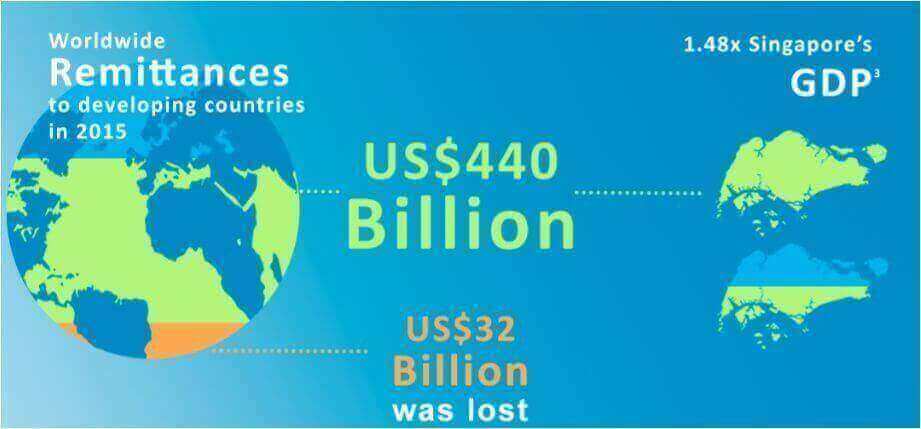
In 2015, US$440 billion in remittances was sent back to developing countries, but US$32 billion was lost due to high transaction fees incurred during the process, and much more went unaccounted due to informal channels!
Sounds complicated? Fret not! Let us demystify the Cross-Border Payments Ecosystem for you.
The cross-border remittances market is dominated by players like banks and money transfer operators. Traditional ways of transferring money overseas are expensive due to high transfer charges along with hidden fees which are not known to clients. While different in their approaches, the traditional remittance services providers have their own strengths and weaknesses.
BANKS
Though banks do not specialize in remittances, they are an essential part of the remittance industry, as they provide the infrastructure that enables money transfers. Major banks are also licensed, trustworthy, and can provide users with other monetary services such as a bank account.
MONEY TRANSFER OPERATORS (MTOs)
More specialized than banks, MTOs provide remittance services that are simpler and faster than banks. MTOs typically have the advantage of speaking the local language, and can provide instant cash, unlike banks which can take days to process. (Source: MasterCard Report, 2011)
The traditional remittance services providers go through multiple steps to get your money across borders. This process racks up hidden bank and MTO fees for you and your recipient, it's no surprise that the person you're sending money to doesn't get the same amount that you send. Here's how your money gets "lost" in the process:
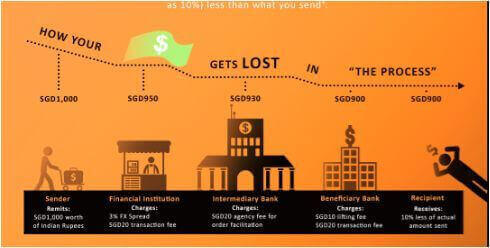
*Banks have an internal exchange rate with other banks (the inter-bank exchange rate), but charge customers a higher exchange rate to earn profits from the difference. (Source: Moving with The Money, an Instarem-Medici Report)
How Cross-Border Payment Methods Are Getting Disrupted
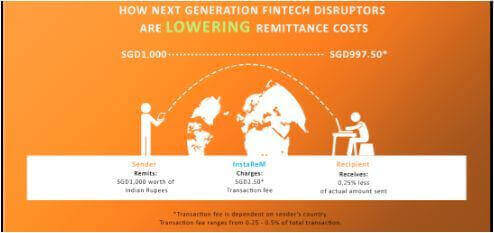
According to the World Bank, sending remittances costs an average of 7.32% of the amount sent. Fintech-based start-ups like Instarem are disrupting traditional methods of money transfers by removing the FX spread and other hidden fees that are common with traditional remittance players. With its automated platform and strong relationship with banks, Instarem is able to offer transparent international money transfers at a fraction of a cost, compared to the traditional players. Unlike banks, Instarem does not require users to physically authenticate their identity, thanks to the implementation of eKYC (Electronic Know Your Customer). This ensures a fast and cost-efficient remitting process. Here's an infographic that breaks down the process of cross-border remittances for you.
About Instarem
Instarem is a Singapore-headquartered cross-border payments company. Founded in 2014, Instarem is licensed as a Money Services Business (MSB) in Singapore, Hong Kong, Australia and Canada. It powers local payments to more than 50 countries across the globe. Instarem has created a unique payment mesh in Asia, which is being leveraged by financial institutions, SMEs and individuals to make fast low-cost cross-border payments.
Categories


Similar Articles


Uzbekistan Money Transfers with Profee
Compare Profee's fees and exchange rates for Uzbekistan transfers, learn how transfer speed and security work, and follow five steps to send your first payment.

Wise vs Revolut: What Are The Differences?
Compare Wise vs Revolut on fees, exchange rates, features, and more. Find out which provider is better for your international money transfers.
How To Save On B2B International Transfer Fees
Learn how to reduce B2B international transfer fees. Discover faster, cheaper fintech alternatives for cross-border business payments.