
Best Ways to Send Money Internationally
Table of Contents
- What are the best ways to send money internationally?
- The world is getting smaller
- How to send money internationally?
- How to send money overseas?
- Carrying Cash during overseas travel
- Carrying Travelers Checks during overseas travel
- Transfer Money through a money transfer agency
- Wire Transfer
- Send money internationally via an app
- Online Money Transfer
- Conclusion
What are the best ways to send money internationally?
In this blog post, we will discuss some ways to send money overseas, and go into some pros and cons of various available approaches to do so.
The world is getting smaller
The modern world that we live in today is a small world. What we mean by that is that it is much more easier for people to travel overseas for various purposes - leisure, education, work (short, medium or long term), business and immigration. The number of people leaving their homeland to pursue education and opportunities overseas is continuously increasing.
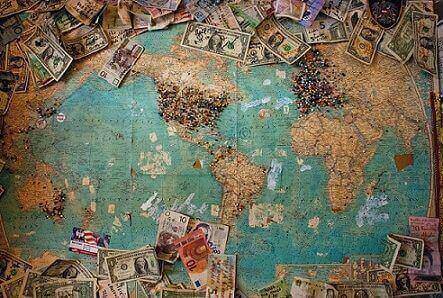
According to Wikipedia, in 2019, the United States, Germany and Saudi Arabia had the largest number of immigrants of any country, while Tuvalu, Saint Helena and Tokelau had the lowest.
In terms of percentage of population, the Vatican City, the United Arab Emirates and Qatar had the highest, while Cuba, Madagascar and China had the lowest. India and Mexico had the highest numbers of native-born persons living in a foreign country, while Tokelau and San Marino had the lowest.
For more details, refer to the full Wikipedia article on countries and states listed by immigrant population.
Additionally, according to the latest UN Report on International Migrations, an estimated 258 million people live and work in an overseas country - this amounts to 3.4% of global population. This 2017 data point represents an increase of 49% over the number of global immigrants in 2000.
In addition to these published figures, there are potentially millions of people traveling overseas for short term work assignments, vacations, education, sport, leisure, etc. Even though such folks do not settle down permanently in the visiting country, but from a global economic standpoint, they make significant contributions to keep the global economy vibrant.
So, when we combine immigrants living in foreign countries with this community of temporary travelers, we can easily imagine the huge impact that people movement - short, medium and long term - has on the global economy.
How to send money internationally?
All the scenarios we discussed above cause people to transfer money overseas. All of the various endeavors that these globally moving people undertake need them to find the cheapest ways to send money internationally to and from host and destination countries.
In fact, according to the latest results published by the World Bank, money transfers abroad to low and middle income countries reached USD 466 billion in 2017 - this is an increase of 8.5% over 2016. The same statistic for high income countries in 2017 is USD 613 billion, which represents a 7% growth over 2016.
The top most global remittance recipients in 2017 were India with $69 billion, followed by China with $64 billion, the Philippines with $33 billion, Mexico with $31 billion, Nigeria with $22 billion, and Egypt with $20 billion.
From an immigrant and international citizen's perspective, the answer to the question - how to send money internationally for free or at cheaper costs - is therefore very important. Every individual would want to maximize the power of their money, and ensure that their money achieves the highest yield when it comes to international money transfers.
How to send money overseas?
Below we discuss some of the best ways to send money overseas from one country to another.
Carrying Cash during overseas travel
The oldest solution to the problem of how to transfer money internationally is simply taking it along physically when traveling overseas! Whilst this could be convenient and easy - definitely big advantages - there are some issues with this approach.

Every country will have a limit to how much cash can be brought in by an incoming traveler. For example, when traveling into the US, visitors are allowed to carry up to USD 10,000 without the need to fill any paperwork or forms.
Secondly, this approach needs either the conversion of source currency to target currency in the home country, or at the destination. Typically, this is done at currency exchanges at airports or banks. Such agencies usually provide a sub-optimal exchange rate, and one ends up losing money as part of high currency exchange fees and/or low exchange rate.
Next, carrying cash comes with the risk of physical loss or theft of money. Finally, due to the limits imposed by the destination country, this may or may not work depending on how much money needs to be moved.
Carrying cash is easy, but there are limits to how much you can take. Additionally, cash currency exchange generally involves sub optimal exchange rates.
Carrying Travelers Checks during overseas travel
This approach is very similar to the cash approach we talked about, but with the security that Travelers Checks can be replaced if lost or stolen. While this helps mitigate the security concerns inherent in carrying cash, the other issues of limits and potentially bad exchange rates still apply.
Transfer Money through a money transfer agency
Another popular way to send money overseas is to use the services of a money transfer company with physical brick and mortar offices. Many such agencies are located in popular places like shopping malls, retail outlets and other such places that people frequently go to.
For example, one can use Western Union to send money internationally.
In this case, the transfer happens cash to cash, albeit mediated by the agency. The sender walks into the agency office, and pays transfer amount, usually cash (although payments with credit/debit cards are also possible, but they usually come with higher fees). The agency charges a fee and quotes an exchange rate, which could be better than airports et al., but may still not be the best exchange rate that one can get.
It takes a few days for the money to move to destination country (in some cases, depending on the agency, and the countries involved, this could be an instant transfer as well). The recipient walks into the agency office in the destination country and provides identification to prove they are the rightful recipient. The agency office verifies identity and pays cash to the recipient.
This method continues to be really popular as it has been historically established to work well, and global money transfer agencies continue to have a great outreach to even remote locations - either directly or through agent networks. The downsides involve a relatively longer transfer cycle time, sub-optimal rates and generally lower transfer limits.
Cash transfer via a money transfer agent is convenient, but may not happen at the best exchange rate available.
Wire Transfer
Most banks offer a wire transfer service whereby money can be sent from one bank to another. The advantage of this approach is that it is generally feasible to send large amounts, while the cons are not getting the best rate and usually very slow transfer times.
The time taken to realize an international wire transfer depends on few factors - some of these include the type of banks involved, number of interbank transfers needed and holidays/weekends, etc.
When transferring money from/to big global banks (for example, Citibank, HSBC, and major national banks of the transfer countries involved), transfer should be faster as major banks have interbank transfer networks and generally exchange big amounts on a daily basis.
If either the source or target accounts are hosted in smaller regional or local banks (state/city banks, credit unions, etc.), there will be more hops involved in the money transfer.
In the worst case, money may go from a small originating source bank to a major national bank, from there to a major international bank for interbank transfer to another international bank overseas, and finally to the smaller bank in the destination country.
Bank to bank transfers can be convenient, especially for moving large sums of money abroad.
Finally, banks generally do not process transactions on weekends and holidays. If the number of hops involved is higher, local holidays in either country can further slow down the process.
Send money internationally via an app
There are companies who dedicate themselves to send money abroad. For example, you can send money internationally with PayPal, or similar apps. That said, most of these services come with fees and may not provide the best exchange rate either.
Online Money Transfer
With the explosive growth of the internet, online remittances are becoming an increasingly popular option. Both established money transfer operators that used to operate via the traditional brick and mortar agency model, as well as new FinTech startups are active in this realm.
Online is the new way to go as the global remittance user community is increasingly using the internet for everything from shopping to education to work to financial transactions.
Conclusion
Whilst there are many ways to do international money transfers (including carrying cash when you travel), sending money online is a cost effective, fast and secure way. Check your options, and compare the pros and cons of each money transfer service before you decide which method to use.
Additionally, when sending money overseas, tax implications and legal restrictions are also something to keep in mind. Make sure you arm yourself with the right knowledge before making such overseas transfers.
Categories


Similar Articles


US Big Beautiful Bill's Impact On Remittances
The Big Beautiful Bill has been passed in the US, and remittances are impacted. Learn how the Bill impacts remittances and what to do if you are affected by the new law.

Bangladesh Remittance Cash Incentive: All You Need To Know
Learn how Bangladesh's remittance incentive works and how you can earn an extra 2.5% when sending money home from abroad.
The Ins And Outs Of International Mobile Money Transfers
Learn how international mobile money transfers work, including fees, security, and tips to send money abroad using your mobile device.